Find a porta potty rental company, anywhere.
PottyDirectory is a national commercial directory for portable restroom rental — 3,418 verified providers across 2,319 cities and all 50 states, with a public pricing index and city-level demand coverage.
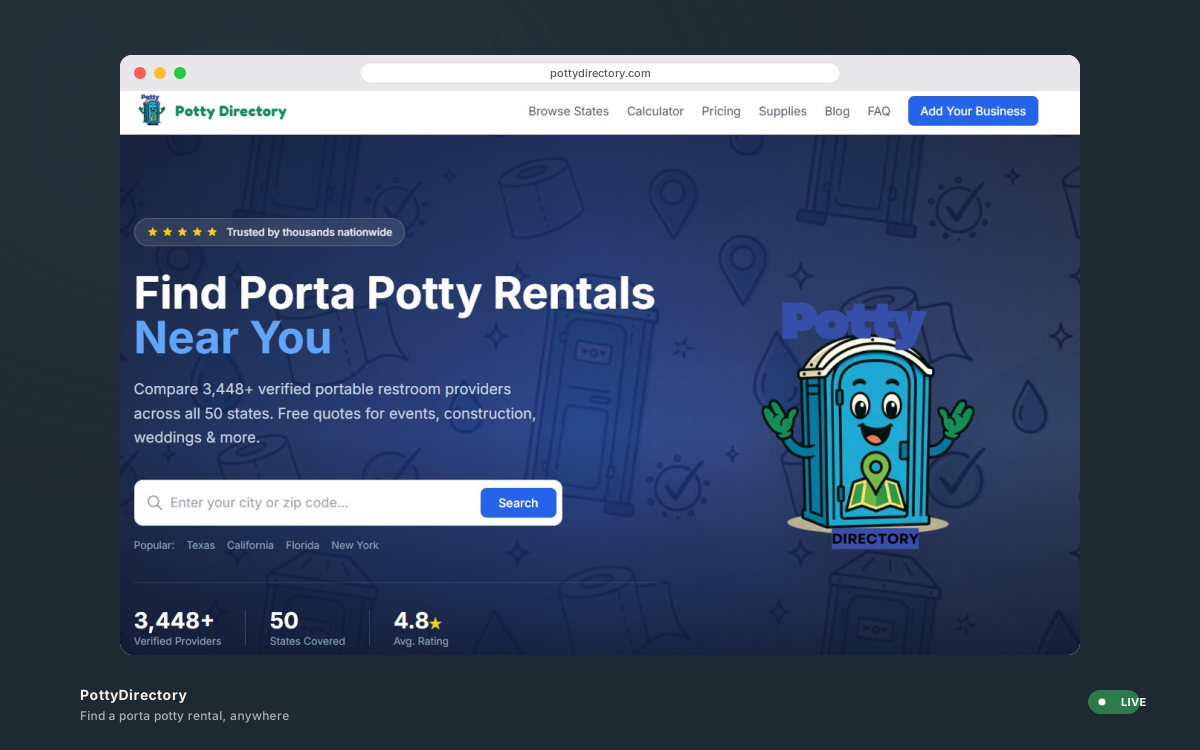
Porta potty rental is high-intent, fragmented, and almost entirely SEO-driven. An event planner or a construction PM mid-pour needs a phone number now, and Google Maps surfaces the same three national operators in every metro.
Ascend repositioned the site from informational restroom content to commercial rental intent: a national hub, de-cannibalized city pages, a public cost-by-state pricing index, and a demand map — every surface reading from one live source of truth.
3,418 providers across 2,319 cities and all 50 states, drawing 170,808 search impressions per 90 days at average position 16.6 — a large indexed footprint still climbing toward page one.
TL;DR
PottyDirectory is a national commercial directory for portable restroom rental — 3,418 verified providers across 2,319 cities and all 50 states, at a 4.62 average rating. It is built on Astro, Supabase (Postgres with row-level security), and Cloudflare Pages, with Pages Functions running the lead funnel and admin tools.
The defining work of 2026 was not a redesign. It was a product repositioning: the site started as an informational restroom-finder and was deliberately moved to commercial rental intent. Informational content came out, internal links were repointed, a national hub was built, and overlapping city pages were de-cannibalized.
Over the 90 days to July 24, 2026, the site drew 170,808 search impressions and 1,077 clicks — a 0.63% CTR at average position 16.6. That is the honest read: a large, well-indexed footprint that is still ranking mostly on page two, with impressions far outrunning clicks. An independent audit scored the site 75/100 on AI readiness with 99 of 100 pages indexable. Monetization is AdSense (live since Feb 9, 2026), the Amazon affiliate program, and a Verified-Badge / featured-listing program.
The problem
Porta-potty rental is a high-intent, fragmented, and almost entirely SEO-driven category. A wedding planner with 200 guests, a construction PM mid-pour, a city events coordinator the week before a 5K — these buyers know exactly what they need and want a phone number now. Google Maps surfaces the same three national operators in every metro. The category’s incumbents are SEO blog farms (homeyou.com, fixr.com), national rental brands with deep blog libraries (BigRentz, United Site Services, WM), and a handful of regional aggregators. There was no neutral directory that covered every state and every city.
The product hypothesis was simple: build a programmatic directory deep enough to rank for the long tail (state + city + service combinations), then monetize through AdSense first and a paid-listing / lead-routing layer second. The model already worked for record stores, public restrooms, and a dozen other “find a local X” verticals. Portable restrooms had the right shape: thousands of operators, no dominant directory, high commercial intent per search.
The harder problem — the one I underestimated at launch — was that bot traffic, scraper noise, and unblocked AI crawlers were each going to change what “the site is working” actually meant. Solving each of those is what turned PottyDirectory from a vanity directory into an asset.
The repositioning
The single most important decision in this project was to stop being a restroom finder.
The original product was informational: where is a public restroom near me. That audience is large, has no commercial intent, and is worth almost nothing per visit. The rental market is the opposite — an event planner with 200 guests or a construction PM mid-pour has a budget, a deadline, and a phone in their hand. Same subject matter, entirely different buyer.
So the informational restroom content was removed outright rather than left to rot, and internal links were repointed at commercial intent. A national “restroom near me” hub was built to consolidate the queries worth keeping, and the overlapping city guides that had been competing with it were de-cannibalized. The NYC city page was differentiated as a proof of concept; once it worked, the pattern rolled to 21 more top-metro city pages.
Two new data-backed surfaces came out of the same push. A public cost-by-state pricing index, with question-shaped FAQ copy and FAQPage structured data, gives the site something to be cited for rather than merely ranked for. A demand and coverage map consumes a per-state search-demand snapshot pulled from Search Console, so the site can show where demand is actually growing.
Underneath all of it, every statistic on every surface — homepage, cost-by-state, demand, data, methodology — now reads from a single getStats() query against the live Supabase table at build time. There are no hardcoded totals anywhere, and the build is drift-proofed on prebuild. That is why the numbers in this case study match the numbers on the site.
The technical approach
The whole site is one Astro project deployed to Cloudflare Pages, with the data layer in Supabase Postgres. Every page is built at deploy time from Supabase rows. There is no edge SSR — output: 'static' keeps the build cheap and the cache surface large.
Data model. One canonical potty table holds every vendor: business name, slug, city, state, geocoded lat/lng, phone, email, hours, photo URL, services, plus boolean flags (has_luxury, has_ada, has_trailer, serves_construction, serves_events, verified, psai_member). Three smaller tables back the operational layer — submissions (vendor self-serve intake), quote_requests (lead funnel), and contact_messages (the contact form). Supplemental tables hold city content, FAQ content, and blog posts.
Programmatic directory pages. Astro’s getStaticPaths builds the page tree from Supabase at deploy time. State indexes (/[state]), city indexes (/[state]/[city]), and vendor detail pages (/[state]/[city]/[vendor]) are all driven by the same query layer in src/lib/supabase.ts. An early lesson: Supabase’s PostgREST client caps responses at 1,000 rows, so the data layer paginates aggressively — without that, half the directory simply disappears from the build. Empty city pages are marked noindex rather than 410’d, so they exist for users who follow internal links but don’t dilute the indexable surface.
Schema markup. Every page emits Schema.org JSON-LD: LocalBusiness on vendor pages, ItemList of LocalBusiness on city pages, Article + BreadcrumbList on blog and trust pages, Dataset on the open-data page. An audit on May 7 caught that the city-page ItemList was missing address, geo, and image on the nested LocalBusiness items — a single template fix on May 9 unblocked LocalBusiness Carousel rich results across roughly 2,500 city pages.
Lead funnel. Cloudflare Pages Functions in functions/ handle the dynamic surface — quote intake, listing intake, admin endpoints, lead forwarding, and a token-based claim flow. Two shared helpers do all the heavy lifting: a SendGrid wrapper that renders brand-matched HTML emails (Deep Navy header, Signal Green accent, Fredoka display font), and a thin PostgREST client that handles inserts, selects, and slug generation without bundling the Supabase SDK. Row-level security on the public tables is anon-INSERT-only; admin endpoints use the service-role key.
Admin console. A single /admin Astro page, gated by Cloudflare Access to one Google account, exposes two tabs: Leads (incoming quote requests, with row-expansion, forward-to-vendor, and outcome tracking) and Submissions (new vendor approvals). A debounced vendor-picker combobox replaces the original “type the vendor slug by hand” prompt — a real friction point that bled into a misrouted lead before it got fixed.
AI citation strategy. The site ships an llms.txt source-of-truth file at the root, an /methodology page that documents how the directory is built and maintained (a Wirecutter-style trust page), and an /data page that publishes aggregate vendor statistics with full Schema.org/Dataset JSON-LD and a Markdown/APA/BibTeX citation block. The goal isn’t more pages; it’s to be the page an AI engine cites when it answers a porta-potty question.
What I shipped
The directory itself. 3,418 verified providers at this writing across 2,319 cities and all 50 states, at a 4.62 average rating — down from a 3,584 peak after a Tier 1 cleanup of 137 misclassified non-porta-potty businesses. Provider records were assembled from scraping, manual research, the Portable Sanitation Association International (PSAI) operator roster, and a self-serve submission flow.
Programmatic city pages. 2,319 city pages, each with a vendor list, an interactive Mapbox map with clustering, top-cities cross-links, and a unique SEO-content block for the 249 highest-traffic cities.
Vendor detail pages. Every vendor gets a full page with map, hours, services, social links, schema.org markup, and — when we have an email on file — a Request-a-Quote form. Vendors without an email see a Call/Visit-website fallback instead of a form that would go nowhere. This gate was added after a real customer’s request was misrouted through the form to a vendor that couldn’t act on it.
Lead funnel. Request-a-Quote form → quote_requests row → branded user acknowledgment email + branded admin alert. From the admin console, I forward the lead to the right vendor with one click. The vendor email includes a unique 30-day claim-token link they can use to update their own listing without an account — a self-healing data loop where every lead becomes a verification touchpoint.
Admin console. Leads tab with expand-row detail, vendor-picker autocomplete, and outcome tracking (awaiting | won | lost | no_response) on each forwarded lead. Submissions tab for approving new vendors with one click — approval promotes the row from submissions to potty and emails the vendor the live URL. Cloudflare Access at the edge does the auth so the function code carries no auth logic of its own.
Self-serve vendor flow. /submit form for new vendors, /get-verified form for the badge program, claim links on every forwarded lead email so vendors can correct their own data. All three write to Supabase and notify me by email — no third-party form relays in the loop.
Trust / AI surface. /methodology (433-line Wirecutter-style trust page, Article schema), /data (full Dataset JSON-LD plus a downloadable summary of vendor counts by state, with a Markdown / APA / BibTeX citation block), and /llms.txt at the site root. Footer links to both Methodology and Open Data so the anchors are reachable from every page.
Content layer. 30 blog posts on luxury restroom trailers, cost guides, planning calculators, and city-specific guides — all under a single editorial layout with Inter for body, Fraunces for headings, and shared callout / FAQ / table components. The 10 highest-traffic posts were rewritten in May 2026 with H2 = literal user query + 40-60 word answer paragraph, aimed at featured-snippet capture.
Monetization. AdSense live since Feb 9, 2026 (publisher ca-pub-2962780862577949), Amazon affiliate links across the supplies index, and a Verified-Badge program that exchanges badges for backlinks. The Sponsored Listing tier is being repositioned: not about placement on the page, about lead priority in the routing layer.
Outcome
Search performance. Over the 90 days to July 24, 2026, PottyDirectory drew 170,808 impressions and 1,077 clicks from Google — a 0.63% CTR at average position 16.6. Five days earlier the same window read 164,826 impressions and 1,062 clicks, so the impression base is still growing. Those numbers are not smoothed: a 0.63% CTR at position 16.6 means the site is well-indexed and ranking on page two, with impressions far outrunning clicks. The indexed footprint is real; the ranking is the work that remains. This data is not a screenshot — Ascend’s own gsc-cron ingests Search Console into the seo_metrics table in ascend-db on a rolling 90-day window, which is what makes the claim auditable.
Real-traffic baseline. Before May 5, GA4 was reporting ~7,200 sessions/month. A diagnosis on May 5 — filtering for Average engagement time > 10s — showed that ~92% of pre-fix sessions were bots or non-engaged drive-bys. The real-human floor is approximately 570 sessions/month, of which ~325/month is Google organic, ~63/month is AI engines (ChatGPT + Copilot), and the rest is Bing, DuckDuckGo, Yahoo, and small referrals. That’s the number the strategy is now planned against — not the inflated total.
AI is the highest-quality channel. Copilot users average 110 seconds of engagement per session — three times the Google organic average of 35 seconds. Bing organic averages 66 seconds. AI referrals are small in volume (~63/month) but qualitatively the best users on the site.
Lead funnel works. Four organic leads landed in the first 72 hours after the funnel went live on May 9, with zero ad spend. The fourth lead exposed the misclassified-vendor problem (a medical supply company got routed a porta-potty quote), which became the forcing function for the Tier 1 cleanup that purged 137 junk rows.
AI-citation audit baseline locked. Run 1 of the citation audit on May 6 returned 0 / 100 citations across 20 queries × 5 engines (Bing Copilot, ChatGPT, Perplexity, Gemini, Claude). That zero isn’t despair — it’s a baseline taken seconds after I discovered that Cloudflare’s “Block AI bots” rule had been silently 403’ing GPTBot, ClaudeBot, PerplexityBot, and anthropic-ai across the entire zone for the site’s whole crawl history. The bots never had access. The crawler block has since been lifted and verified — GPTBot, ClaudeBot, PerplexityBot and Googlebot all return 200 — but a second citation audit has not been run, so there is no measured citation figure to report yet. Deciding how to measure citation properly is an open item, not a solved one.
Monetization status. AdSense impressions and clicks are accumulating; YTD revenue pull is pending [verify]. The Amazon affiliate tag jbmangum27-20 is wired into the supplies index. The paid lead-priority tier is the next monetization line being built.
Lessons
Bot traffic will lie to you for as long as you let it. GA4’s default report on PottyDirectory was 96% bot sessions, which made every other metric — bounce rate, time on page, channel mix — meaningless. The fix was a single engagement-time filter in GA4 Explorations. Until you do that on any directory site with public NAP data, your numbers are fiction.
Cloudflare can silently kill your AI strategy. The “Block AI bots” managed rule defaults aggressively. For the entire crawl history of the site, GPTBot / ClaudeBot / PerplexityBot / anthropic-ai had been getting 403’d at the edge — including from /llms.txt, the one file I was deliberately publishing for them. robots.txt saying “Allow” doesn’t override the WAF. I now check this on every Cloudflare-hosted property before any AI work begins.
Don’t trust your scraper’s category column. A medical supply company was misclassified as a porta-potty vendor and got a real customer’s quote forwarded to it. The cleanup pattern that caught the rest of the false positives looks for non-porta-potty keywords (hardware, food service, agricultural, equipment rental, medical, office, storage) and excludes anything that mentions porta-potty, portable toilet, restroom, or sanitation in name, services, or description. 137 vendors dropped on a single pass. Roughly 145 mixed-overlap rows (plumbing, septic, dumpster) need a human eye and were deferred.
Supabase RLS has silent failure modes. Anon-key .update() calls on a table without an UPDATE policy return {data: [], error: null} — no error, just nothing changed. PostgREST’s Prefer: return=representation runs an implicit SELECT-back that fails on anon-INSERT-only tables with a misleading “row violates RLS policy” error; the workaround is return=minimal and parse the new row id from the Location header. Both lessons are now saved as portfolio-wide memories.
Markdown is for prose, not state. Several earlier sessions ended with the day’s task list dropped into a tasks/*.md file. Within a month, those files were stale and contradicted each other. Tasks moved into a purpose-built CRM on Cloudflare D1 — and then moved again, once that queue started drifting from the workspace where everything else was tracked. Two systems both claiming to hold the task list is the same failure as ten markdown files, just tidier. The lesson survived both moves: markdown is for narrative, design briefs, and audit logs, never for anything that has a status. And a status lives in exactly one place.
The first lead is what makes the funnel real. Three days after Request-a-Quote shipped, four real customers had submitted quotes. Every weakness in the system surfaced inside that 72-hour window — the slug-hunt admin UX, the misclassified vendor, a Web3Forms-leftover form that bypassed the admin queue. None of those were findable in code review. The funnel had to be carrying real money for the bugs to show up.
What this means for your business
If you have a category that’s fragmented, SEO-driven, and lacks a neutral directory, the same shape of build applies. The cost structure is friendly: one Astro project, one Supabase project, one Cloudflare account, ~$6/month in infrastructure for a site doing 6,000 pages and a working lead funnel. The cost is in the data — sourcing, deduping, and gating the bad rows before they cost you a misrouted lead.
The bigger lesson is that an AI-citation strategy is no longer a “later” item. AI traffic is small in volume on directory sites today but two to three times the engagement quality of Google organic. The work to be cited is the same work that makes the site trustworthy to humans — a methodology page, an open dataset, an llms.txt source of truth, schema.org markup that actually validates. Build for the engines that quote you, not just the ones that rank you.
If you have a directory idea or a vendor / supply-side marketplace you want to spec, the discovery sprint is how it starts. Or run the numbers on the cost calculator.