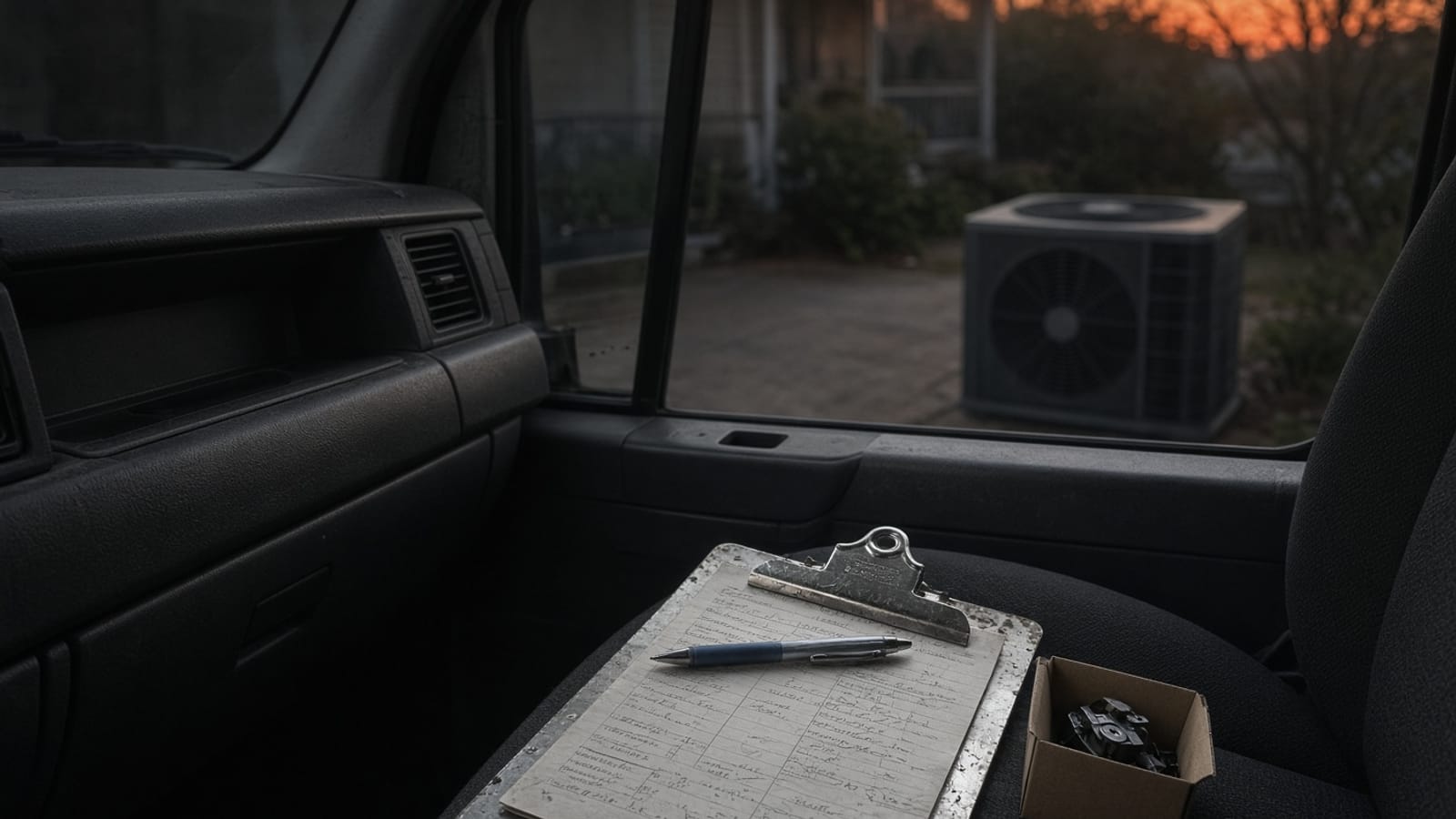
The last call of the day wraps up. On the clipboard: the model number off the condenser, the part the tech swapped, the part he wants to bring back Thursday, and a note that the customer's dog bites. The sheet rides home in the van.
The next morning the office manager types it into the field software. She calls the tech to read his handwriting. The Thursday part never gets ordered, because it was written in the margin.
That is the end-of-day re-key. It survives the software purchase, too: shops that pay for ServiceTitan or Housecall Pro run it every morning. Nobody puts a cost on it, because it never shows up as a line item. It shows up as a morning.
Why the clipboard wins
The tech has an app, and the app has a close-out screen. Look at what that screen asks for: the fields the office needs, on a phone, in a driveway, at the end of a long day. It gives the tech nothing back. Paper is faster and asks for less.
So the tech picks the clipboard, and given what the screen offers, that is a sensible choice. The usual verdict is that techs won't use apps. The better read is that nobody made the app worth using at 5 o'clock.
Then the office does the tech's data entry on top of its own. Because it happens every day, it feels like part of the office job, and nobody asks whether it should exist.
What it costs your shop
I can't give you a figure for your shop, because I haven't seen it. Here is how to get one yourself in a week.
- Tally the mornings. Ask the office manager to keep a note for five working days: which jobs got re-typed, roughly how long each took, and how many calls went to a tech to decode something.
- Read five closed jobs against the paper. Pull five jobs from last week and lay the sheet next to what's in the system. Look for the part numbers, the follow-up notes and the "customer asked about a second unit" lines that didn't cross over.
- Count the promises. How many times did a tech tell a homeowner "I'll have the office call you" and the office never did?
The third count is usually where the money is. Re-key time is annoying. A follow-up promised in the driveway that never got booked is lost work, and it never appears in a report, because it never became a job.
Three fixes, cheapest first
1. The two-question text. Before the van leaves the driveway, the tech answers two questions by text: what's left to do at this address, and do you need a part? The person who knows types the answer, in their own words, while they still remember. It works on any system and needs nothing built. The office reads the replies first thing and turns them into tasks.
2. Cut the close-out screen to what matters tomorrow. Go into the field software and make the required fields the ones that drive the next visit: follow-up needed, part needed, notes for the next tech at this address. The office can fill the rest from the invoice. The major field service platforms let you configure this. It is an afternoon of setup that most shops never do.
3. Connect the middle. ServiceTitan and Housecall Pro both publish APIs, which means information can land in the job record without a person typing it. This is where AI is useful in a trade shop: reading what is already written or said and putting it where it belongs. A photo of the data plate becomes a model and serial number in the equipment record. A short voice note from the driveway becomes a follow-up task with a date on it. That is a build, so it comes third, after the first two fixes have shown you which fields actually matter.
What I'd do first
Run the week of tallies. If the re-key is small and every promised follow-up got booked, you've spent five mornings confirming that part of your shop works, and you can stop thinking about it.
If the counts are bigger than you expected, start with the text. Then fix the screen. Talk about a build once those two have told you what the build needs to do.
Tracing one job from phone call to money in the bank, and counting every re-type along the way, is the first thing the AI Audit does. If the biggest leak in your shop is somewhere other than the truck sheet, the audit finds that instead. And if there's nothing worth building, I'll tell you.