The directory for independent record stores.
Record collectors had no good way to find independent stores outside their city. RecordStops built the go-to directory — state by state, city by city — with store profiles, hours, and curated city guides.
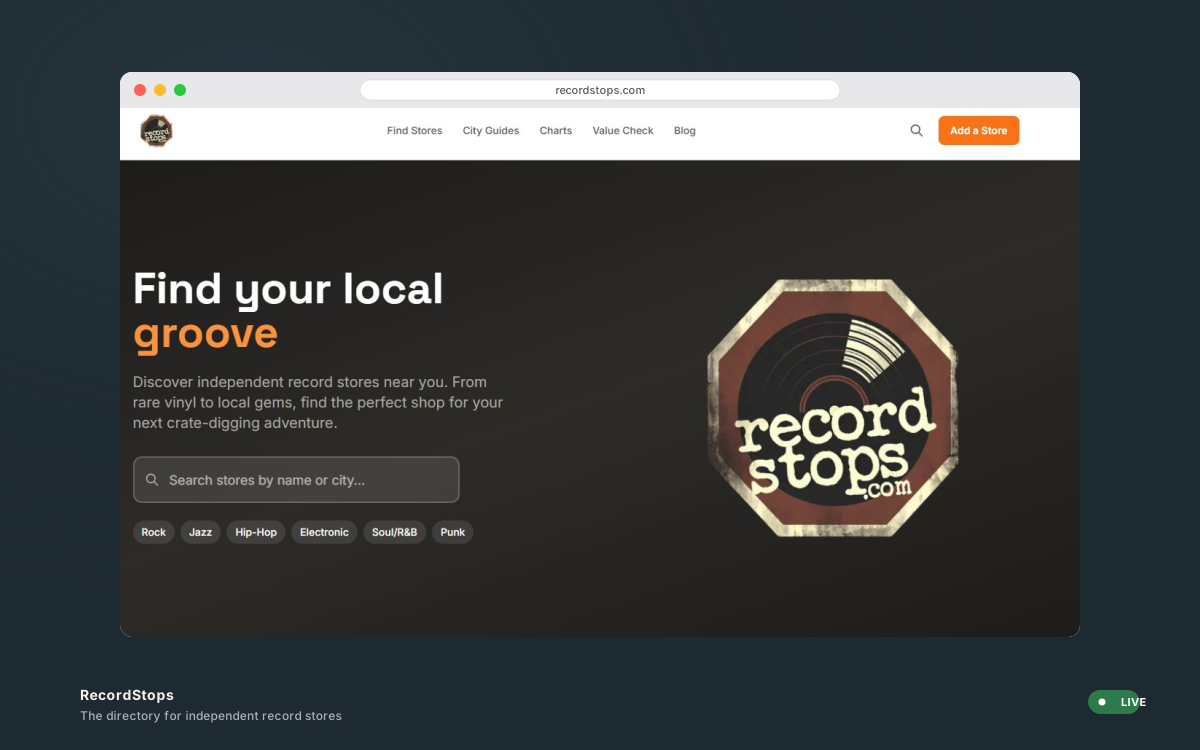
Independent record stores are scattered and invisible online. Platforms like Google Maps surface chains over hidden gems.
A programmatic directory built on Astro + Cloudflare D1 with city-guide templates that target long-tail search queries. Each store gets its own SEO page; each city gets a curated guide.
296 stores across 177 cities and 16 curated city guides, ranking at average position 10.3 — page one on the long-tail city queries it targets, with no ad spend.
TL;DR
RecordStops is the directory for independent record stores in the US Southeast — 296 stores across 177 cities in North Carolina, South Carolina, Virginia, Maryland, and DC. I built it on Astro and Cloudflare D1 over December 2025 and January 2026, then spent the next four months turning it from a static directory into a working B2B pipeline.
The search results are the interesting part. Over the 90 days to July 24, 2026, the site averaged position 10.3 on a 1.55% CTR — the top of page one on the long-tail city queries it targets, like “record stores in Greenville SC.” That is a materially better ranking position than the much larger directory in the same portfolio, on a much smaller base: 3,940 impressions against PottyDirectory’s 170,808. RecordStops proved the template ranks. It has not yet proved the template scales.
The pitch motion runs on a custom outreach admin I built inside the site after canceling a $497/month CRM that was doing the same job worse. The product is live, monetizing through $15/month Featured Listings, and the work that remains is sales, not engineering.
The problem
Independent record stores are scattered and invisible online. Google Maps surfaces chains and the closest gas station before it surfaces the corner shop that has actually been selling vinyl since 1978. Discogs has store profiles but treats them as inventory feeds, not places you walk into. Yelp results are polluted with closed locations and stale hours. A vinyl collector traveling to a new city has no good way to answer the only question they care about: which stores in this city are worth my afternoon?
The directory shape of this problem is well understood. There are hundreds of “best record stores in [city]” blog posts that rank for those queries, written once and never updated. They miss new stores, list closed ones, and read like SEO filler because they are. The opening was for someone willing to maintain a real dataset — not for someone trying to write content.
That was the consumer-facing problem. The business-facing problem was that store owners themselves had no good distribution channel beyond their own walk-in traffic. A storefront in Durham could be one of the best record shops on the East Coast and a person driving through from Charlotte would have no idea it existed. If I could build the consumer side first, the supply side would have something to plug into — a real audience, a real listing page, and eventually a paid upgrade for owners who wanted the prominent slot.
The bet was simple. Build the directory, prove organic search works, then sell Featured Listings to the owners who already had a free listing. The kill criteria are codified inside the project: by August 1, 2026, if fewer than five stores are paying $15/month, the project pivots or sells on Acquire.com. Numbers decide.
The technical approach
Three pieces of infrastructure do almost all of the heavy lifting: programmatic city and state pages, a thin outreach pipeline that turned the contact list into a sales motion, and a deliberate SEO play built around long-tail city queries.
Programmatic pages. Every store gets its own SEO page. Every city gets a curated guide. Every state gets a hub. The page template is the same; the data swap is what drives the long tail. Astro renders the whole thing statically at build time, pulling from a Cloudflare D1 database called recordstops-db that holds stores, cities, states, and a handful of supporting tables. On every deploy, the build generates 296 store pages, 16 city guide pages, five state pages, and a custom sitemap.xml that lists all of them — because the default @astrojs/sitemap integration was only emitting 21 static routes and Google could not discover the other 315.
The sitemap fix was a turning point. Before February 15, Google Search Console had indexed 21 pages. The morning after the custom sitemap shipped, GSC showed 336 pages discovered. Most of the organic growth since traces back to that single deploy.
Outreach pipeline. This piece evolved twice. Version one used Directory Factory, my own bulk-send tool. Version two migrated to GoHighLevel for the reply handling, form pipeline, and contact lifecycle that Directory Factory could not do. Version three killed GHL entirely and rebuilt the outreach engine inside the RecordStops admin panel — because GHL was costing $497 a month for a workflow I could replicate in two screens.
The admin panel at /admin/outreach reads from outreach_log (an append-only table of every send event) and renders, per store, six template-based dots: V1 / V2 / V3 for the three cold “verify your listing” emails, and F1 / F2 / F3 for the three Featured Listing pitches. Each dot is filled if that template has been sent. A “Stage” column derives where each store sits in the funnel — Cold, Verifying, Bridge, Featured, or Done — and a nextTemplateSlug() function walks the drip order and tells me exactly which template to send next. Verified stores skip the cold sequence and route straight to the Featured pitch.
Organic SEO play. The directory targets long-tail queries that no national content site will bother with — “record stores in Asheville NC”, “where to buy vinyl in Richmond VA”, “best record store Chapel Hill.” Each city guide is hand-curated, not LLM-generated, because the difference shows in search results and shows even more in the few backlinks the site has earned. The state pages aggregate the city guides. The store pages are the long tail.
A handful of supporting Cloudflare Workers keep the data fresh. recordstops-sync pulls Discogs marketplace pricing daily so each store page can show “this store has 1,200 listings on Discogs starting at $4.99.” recordstops-musicbrainz pulls upcoming release dates for the weekly newsletter. recordstops-newsletter builds and sends the Saturday digest through SendGrid. A fourth worker, recordstops-ghl-sync, was built to bridge GHL into D1 — and is now mothballed after the GHL cancellation but kept in the repo as a reference implementation.
What I shipped
The directory. 296 stores across five states, each with hours, address, Mapbox-rendered map, phone, website, social links, and Discogs marketplace metadata where available. Image assets live in Cloudflare R2 under ID-based paths (recordstops-images/stores/<store_id>/hero.webp), keyed by store ID rather than slug so renames do not break references.
16 city guides. Columbia, Greenville, Charlotte, Asheville, Chapel Hill, Durham, Raleigh, Winston-Salem, Charleston, Richmond, Norfolk, Virginia Beach, Baltimore, DC, plus a couple more. Each guide opens with a paragraph of curator’s voice — what the city’s vinyl scene actually feels like — and then lists the stores worth knowing about with a one-liner each. Not “top 10 best record stores in X.” A real, sortable, opinionated list.
Outreach admin panel. Six template-based drip dots per store (V1 V2 V3 / F1 F2 F3), Stage column with client-side filter chips, sortable headers on every column, dropdown to send the next template with one click, and a “last sent” timestamp that reads from outreach_log first and falls back to the legacy email_N_sent_at slots for backward compatibility. The drip itself is three cold “verify your listing” emails followed by three Featured Listing pitches. Two transactional emails — featured-trial-start and featured-week-1-checkin — fire automatically after Stripe payment.
Featured Listings. A $15/month or $150/year upgrade for store owners. Stripe checkout via a hosted payment link, with the resulting webhook flipping a flag on the store row in D1 and promoting the listing’s position in its city guide. The Featured pitch emails reference real numbers — visits last month, search queries the store ranks for, the city guide it would be featured on — pulled from GA4 and from the database.
Newsletter. Weekly Saturday digest covering new arrivals, upcoming releases, and one curated city pick. SendGrid for delivery, MusicBrainz for release data, a Cloudflare Worker for assembly. The send pipeline works; the content variety still needs a fix (a known bug where the same content sometimes ships two weeks in a row, traced to a stale date-range query in the digest worker).
Custom sitemap. A sitemap.xml.ts endpoint that queries D1 at build time and emits every store, city guide, state hub, and blog post. Replaced the default Astro sitemap integration that was only seeing static routes.
Sample-template guardrails. Twice during the build, an unrelated “Groove Haven” sample template polluted the repo when a directory-factory utility scaffold leaked in via git add -A. The .gitignore now blocks the known-bad filenames and the project’s CLAUDE.md mandates grep -rli "groove haven" src/ public/ before any commit. Both incidents are the kind of operational scar tissue that only shows up when you are running the build, the sales motion, and the deploy pipeline yourself.
Outcome
Average position 10.3 at a 1.55% CTR over the 90 days to July 24, 2026 — 61 clicks on 3,940 impressions, per Google Search Console. That ranking is the result worth reporting: the site sits at the top of page one for the long-tail city queries it was built to win, and it earns a click rate more than twice PottyDirectory’s on the same infrastructure.
An earlier version of this case study led with “683 organic visitors a month” from Google Analytics 4. That number does not survive scrutiny and has been removed. GA4 on a public-NAP directory site counts bots and non-engaged drive-bys by default — the same diagnosis on PottyDirectory found roughly 92% of sessions were not real humans. Search Console counts actual clicks from actual result pages, so that is what is reported here, and it is a much smaller number. The ranking is genuinely good. The volume is genuinely small. Both are true, and only one of them was in the original writeup.
336 pages indexed in Google Search Console, up from 21 before the custom sitemap. Most of the long-tail city + store queries now have a RecordStops page sitting in the top 10. A few are in the top three.
One inbound podcast lead, which did not convert. Patrick Foster at Rockin’ the Suburbs Podcast came in through the site’s contact form, found organically. He was followed up with and was not interested. Worth stating plainly because the lead is often where a case study stops telling the truth: a form fill from a stranger who found you through search proves the discovery channel works, and proves nothing whatsoever about the business.
$497/month saved by killing GoHighLevel. The built-in admin panel does verification tracking, drip stage management, and per-store template selection — the parts of GHL that were actually load-bearing for this product. Reply handling and form pipelines I rebuilt as needed; the rest was bloat I was paying for monthly.
4 production cron workers running on Cloudflare’s free tier, each handling one job and logging to its own table. The total infrastructure cost for the directory is under $5 a month — which, when the kill criteria is “five paying Featured Listings,” means the unit economics are not the constraint. The constraint is that I have to actually pitch the stores.
Zero paying customers, and the kill-criteria date has arrived. This is the honest number. The criterion written into the project at the start was five paying Featured Listings by August 1, 2026, or the project pivots or sells. That date is here and the bar was not cleared, so the decision it was written to force is now live.
The infrastructure is built. The sales motion exists in the admin panel. What is missing — and what the project’s own notes flag as “the hard rule” — is that I never sent the pitch emails at the cadence needed to close listings. Building feels productive; selling feels gross. Selling is the work, and not doing it is what the criterion was designed to catch. Writing down a kill criterion is only useful if you honor it when it goes against you.
Lessons
Built-in admin beat a $497/month CRM. GoHighLevel could do everything I needed plus a hundred things I never would. Two screens of Astro + D1 — an outreach.astro admin page and an outreach_log table — replaced the workflow stack I was paying for. The pattern generalizes: if your CRM exists to track “did I send the email yet” and “what stage is this contact at,” the build-cost of replacing it is one weekend. The recurring savings beat the build cost on month one.
The sitemap was the SEO unlock. Before February 15, the site had 296 store pages live and 21 of them indexed. The custom sitemap.xml.ts endpoint took half a day to build and ten minutes to submit in Search Console. Organic traffic followed within the month. If you are running a programmatic site and using a default sitemap integration, verify what is in the sitemap — do not assume the framework figured it out.
Long-tail beats head terms. “Best record stores in Charlotte NC” is competitive. “Record stores in Chapel Hill” or “vinyl shop Durham” are not, and they are what real people type when they are about to drive somewhere. The directory ranks for hundreds of those queries because each store page targets the long-tail version of the question, not the head term.
Own the dataset. Every store row in D1 is something I imported, scrubbed, and verified myself. No third-party API is in the critical path. If Discogs changes its terms tomorrow, the Discogs sync worker degrades to a no-op and the rest of the site keeps shipping. Same pattern as the City of Charlotte EV dashboard: own the database, treat vendor APIs as inputs to your own data model rather than as the model itself.
Engineering is not the bottleneck. RecordStops shipped infrastructure for four months without sending the pitch emails that infrastructure was built to send. The hard rule — “stop building until something is sold” — is there because a year of building and zero of selling is the default failure mode of every product I have shipped. The fix is calendar-blocking time to actually send the emails.
What this means for your business
If you run an SMB in a fragmented market — independent retailers, niche service providers, regional manufacturers — there is a directory shape that fits. A list of all of them, hand-curated, with SEO-optimized pages, that ranks on long-tail city + category queries and becomes the place customers find you. It is not a venture-scale business. It is a $1,000-$5,000-per-month business that runs on a Cloudflare bill of $5 and a few hours a week of curation.
If you sell B2B and your CRM bill is in the hundreds of dollars per month for what amounts to “track which customers I emailed and when,” the math on building your own admin is closer than you think. The first month of savings often exceeds the build cost. The recurring savings compound for the life of the product.
The combination — own the dataset, build the admin, rank on long-tail queries, then sell into the audience you have already built — is the same shape across every kept project in this portfolio. RecordStops is a particularly clean example of it.
If you have a directory idea, a CRM you are paying too much for, or an internal pipeline that needs a custom admin instead of another SaaS subscription, the discovery sprint is how the conversation starts. Or run your own numbers on the cost calculator.