Custom SaaS Development
Custom SaaS development, shipped to production
Subscription software with real billing, real auth, and real users — built end to end by the engineer you actually talk to.
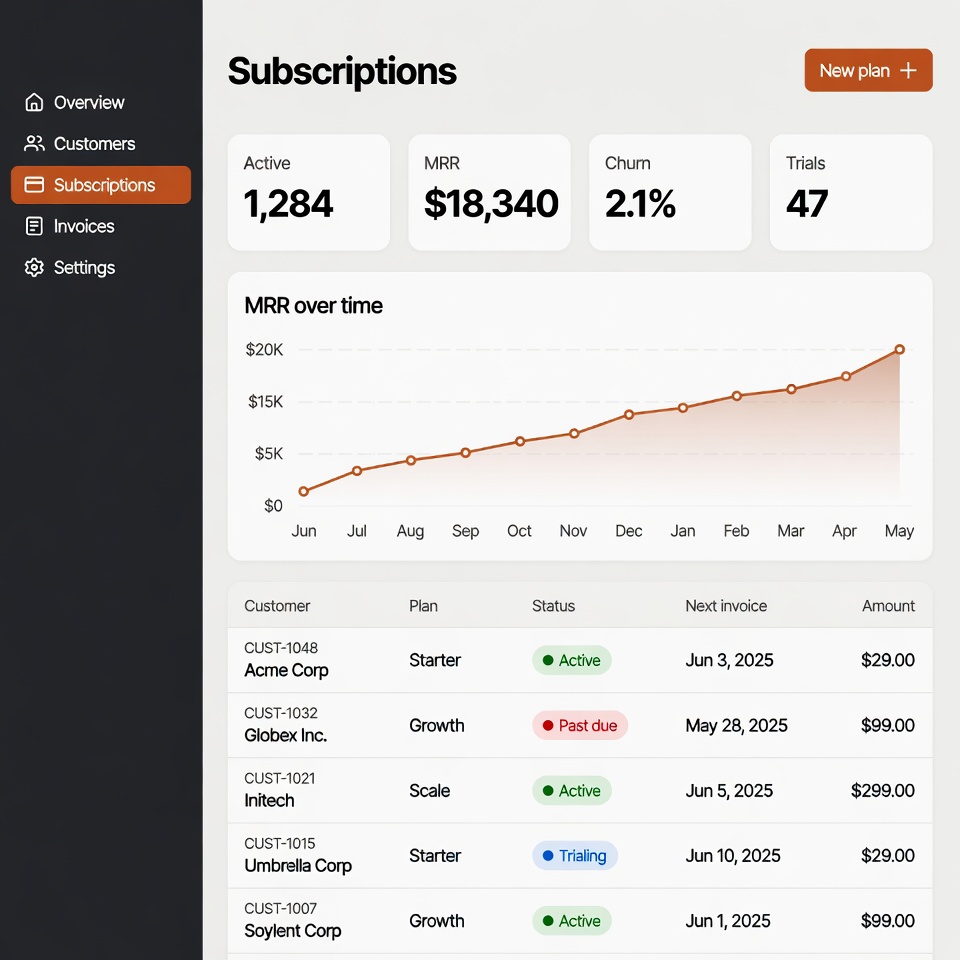
Why most custom SaaS projects stall
The hard part of a SaaS product is almost never the feature you pitched. It is everything underneath: authentication that survives a password reset at 2am, a billing integration that handles a failed card without locking a paying customer out, a database schema that still makes sense after the third pivot, and a deploy process that does not require you to be awake.
Agencies quote the feature list because that is what is easy to quote. The plumbing gets discovered in month three, which is when the change orders start and the timeline doubles. You end up paying twice: once for the demo that impressed you, and again for the production system that has to actually hold up.
The other common failure is subtler. A team ships a working product on a stack chosen for speed of the first demo, then discovers the hosting bill scales linearly with signups, or that the auth provider charges per monthly active user, or that the "serverless" database has a connection limit that a background job blows through. These are cheap decisions to get right at the start and expensive to reverse later.
The pattern that works for owner-operators is unglamorous: pick boring infrastructure with predictable costs, build the billing and auth path first because it is the part that must never break, and get real users on it before adding the second feature. That ordering is the whole difference between a product and a demo.
How an engagement runs
-
Discovery sprint
Two paid weeks that end in a scoped blueprint and a fixed-price build proposal — architecture, data model, integration list, and the honest version of what it costs. If the blueprint is not worth what you paid, the sprint is refunded.
-
Billing and auth first
The subscription path gets built and tested before feature work starts, because it is the code that cannot be broken later. Stripe webhooks, plan changes, failed payments, and cancellation all handled up front.
-
Thin vertical slice to production
One complete user journey — signup through paid action — deployed to a real domain in the first weeks, not a staging environment nobody looks at.
-
Iterate against real usage
Features get prioritised by what actual users do, not by what the original spec assumed they would do. Weekly demos on the running system.
-
Handover you can act on
Documented deploy process, environment variables, and runbook. The code is yours, in your repo, on your accounts, from day one.
Proof
SC DMV Alerts — idea to paying subscribers in under three weeks
South Carolinians were refreshing the DMV scheduler by hand for hours to find a road test slot. SC DMV Alerts monitors all 65 locations every five minutes and emails the moment something opens. It is a complete subscription product — three tiers, Stripe billing, transactional email, and a monitoring pipeline running on Cloudflare Workers and D1 — built and live with paying subscribers in under three weeks.
65 locations monitored · 5-minute check interval · 3 subscription tiers · live and paying
Read the SC DMV Alerts case study →What a custom SaaS build costs
Every engagement starts with a paid two-week discovery sprint. It produces a scoped blueprint and a fixed-price proposal, so the build number is based on a real architecture rather than a guess. Most SaaS builds land between the discovery sprint and the upper end below, depending on integration count and how much of the billing and permissions model is bespoke. You can run your own numbers on the cost calculator before we ever talk.
- Discovery sprint
- from $5k — two weeks, refundable
- Typical build engagement
- $15k – $50k+
- Ongoing
- Weekly retainer or fixed scope
Run your own numbers on the software cost calculator .
Questions about custom saas development
How long does a custom SaaS build actually take?
The discovery sprint is two weeks. After that, a focused first release is typically six to twelve weeks depending on how many external systems it has to talk to. SC DMV Alerts went from idea to live paying subscribers in under three weeks, but that was a deliberately narrow product with one integration. A multi-tenant product with role-based permissions, a payment provider, and two third-party APIs is a different shape. The discovery sprint exists precisely so the timeline you get is based on the real integration list rather than an optimistic guess made before anyone looked.
Do I own the code?
Yes, completely, and from the first commit rather than at final payment. The repository lives in your GitHub organisation, the hosting runs on your Cloudflare and Stripe accounts, and the domain is registered to you. There is no proprietary framework you have to keep paying to use, and no hosting arrangement that makes leaving expensive. If you decide six months in that you want to bring the work in-house or hand it to another engineer, everything needed to do that — code, credentials, deploy process, runbook — is already in your possession.
Can you work with an existing codebase, or does it have to be greenfield?
Both. Roughly half of custom SaaS work is adding a serious capability to something that already exists — putting real billing on a product that has been invoicing manually, adding multi-tenancy to a single-customer app, or replacing an auth system that has become a liability. The discovery sprint covers reading the existing code and being honest about what is worth keeping. Sometimes the answer is that a rewrite of one subsystem is cheaper than working around it, and sometimes the existing code is fine and the real problem is the deploy process.
What stack do you build on, and why does it matter to me?
Typically TypeScript and React on the front end, with Cloudflare Workers, D1, or Supabase and PostgreSQL behind it, and Stripe for billing. It matters for one commercial reason: cost predictability. This stack has a flat, low hosting cost that does not scale punitively with signups, which means your infrastructure bill does not become a surprise line item the month a marketing push works. It is also widely known, so you are not locked into one engineer who understands a bespoke framework.
What happens if we disagree about scope mid-build?
The fixed-price proposal from the discovery sprint is the reference point, and it lists what is in and what is explicitly out. When something new comes up mid-build — and it usually does, because real users reveal things — it gets priced as an addition rather than absorbed silently into the timeline or quietly dropped. You see the trade-off and decide. The failure mode this avoids is the one where scope grows invisibly for two months and then the deadline moves without anyone having consciously agreed to it.
Who actually writes the code?
Brian Mangum, the person you have the discovery call with. There is no account manager relaying requirements to a delivery team, and no offshore contractor whose name you never learn. This is the main structural difference from an agency: the person estimating the work is the person doing it, which removes the estimation gap that causes most agency overruns. The practical trade-off is capacity — a solo engineer takes on a limited number of concurrent builds, so timelines depend on availability.
Related services
- Internal Tools & Dashboards Operations dashboards, admin panels, and workflow software built around how your staff already work
- AI Integrations & Agents Document processing, support agents, and LLM features wired into the systems you already run
- Fractional CTO Senior engineering judgement on retainer
Start with the numbers
Run your build through the cost calculator, or book a 30-minute discovery call to talk through whether a custom product is the right answer at all.