Fractional CTO
A fractional CTO who still writes code
Senior engineering judgement on retainer — architecture decisions, vendor evaluation, and hiring support for owner-operators who need a technical partner rather than another vendor.
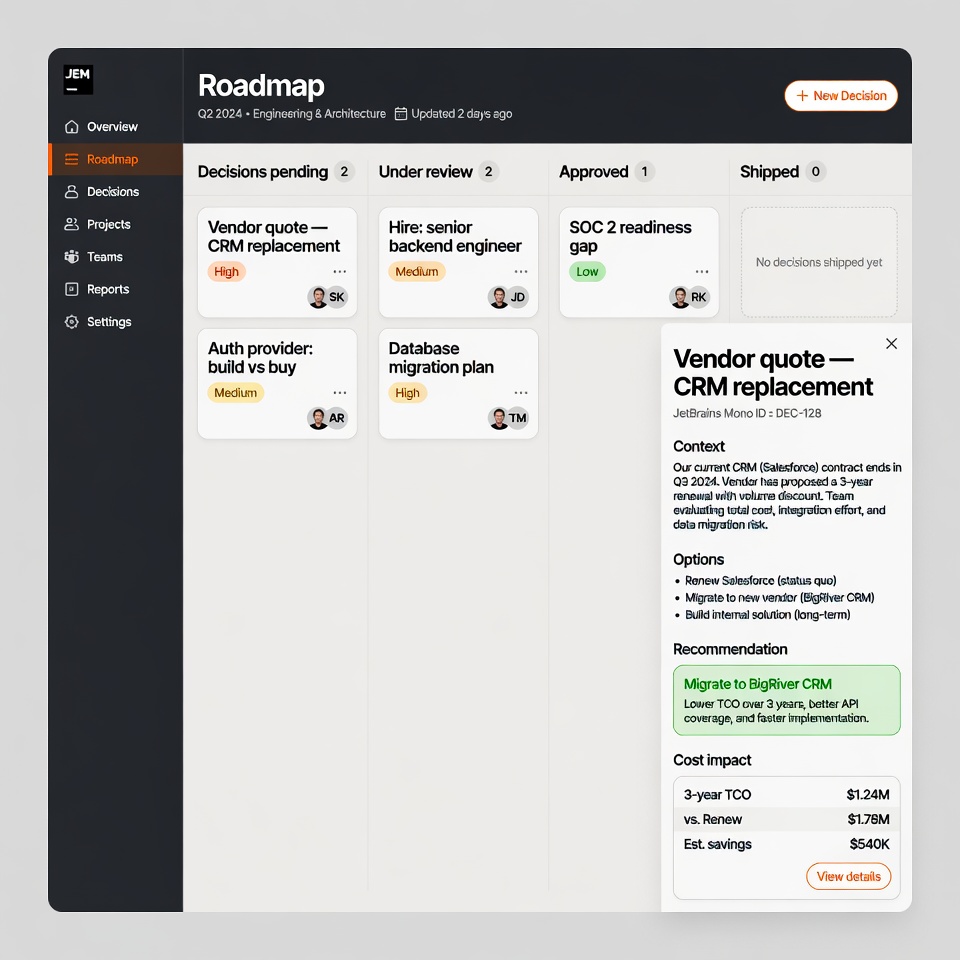
Technical decisions with no technical counterparty
A business without an engineering leader still has to make engineering decisions. Which vendor to sign. Whether the quote is reasonable. Whether the developer you hired is doing good work. Whether the platform you are being sold locks you in. These decisions have consequences measured in years, and they are usually made by someone with no way to evaluate them and no independent party to ask.
The default is to trust the vendor doing the quoting, which works right up until it does not. The second default is to hire a full-time CTO, which for a business of this size is an expensive answer to a part-time question — and often attracts someone who wants to build a team rather than solve the specific problems you have.
What is usually needed is not full-time leadership. It is a senior technical person who understands your business, is available when a decision comes up, has no stake in which vendor you pick, and can read a proposal or a codebase and tell you plainly what is wrong with it.
The distinction that matters is whether that person still builds. An advisor who has not shipped software in five years will give you strategy that sounds right and estimates that are wrong, because the cost of a piece of work is not something you can reason about from memory.
How an engagement runs
-
Understand the business first
Technical strategy that ignores commercial reality is worthless. The first weeks are about how the business makes money and where software helps or blocks that.
-
Audit what exists
An honest read of the current systems, vendors, and contracts — including which are fine, which are risks, and which are quietly expensive.
-
Be available for decisions
The main value is being reachable when a quote arrives or a vendor proposes something. Decisions get made with a technical counterparty in the room.
-
Hire and manage engineers
Writing the role, screening candidates, running technical interviews, and reviewing work — the parts that are hard to do without an engineer.
-
Build when it is faster
Some problems are quicker to solve than to specify and delegate. Where that is true, the work simply gets done.
Proof
SendMyLove — a $0 outcome, published in full
The most useful evidence of technical judgement is not a list of successes. SendMyLove shipped in two weeks, delivered 2,515 messages, and earned exactly $0 in recurring revenue. The case study documents the whole thing publicly: what the assumption was, why the psychology of the product did not work, what the architecture got right, and the decision to sunset v1 rather than keep spending on it. Knowing when to stop is a large part of what a technical partner is for, and it is the part vendors have the least incentive to tell you.
2,515 messages delivered · $0 MRR · v1 sunset deliberately · full post-mortem published
Read the SendMyLove case study →What a fractional CTO engagement costs
Fractional engagements run as a monthly retainer sized to the number of days a month you actually need, rather than as a project with a fixed end. Most owner-operator businesses need considerably less time than they expect — the value concentrates in being available at decision points rather than in a fixed number of hours. Retainers are month to month, because an advisory relationship that needs a long lock-in is not a good sign.
- Structure
- Monthly retainer, month to month
- Sized by
- Days per month, not fixed hours
- Also available
- One-off audit or vendor review
Run your own numbers on the software cost calculator .
Questions about fractional cto
How much of your time do we actually get?
Retainers are sized in days per month, agreed up front and adjusted as the engagement settles. Most owner-operator businesses find they need less than expected, because the value concentrates in availability at decision points rather than in a fixed number of hours logged. A typical shape is a regular check-in, review of anything significant in flight, and being reachable when a quote arrives or something breaks. If the real need turns out to be a full-time engineering leader, the honest recommendation is to hire one — and helping scope and fill that role is legitimate work for the engagement.
Do you actually write code, or just advise?
Both, and the combination is the point. An advisor who has not shipped software recently gives strategy that sounds reasonable and estimates that are wrong, because the real cost of a piece of work is not something you can reason about from memory. In practice some problems are faster to solve directly than to specify, delegate, and review — and where that is true, the work gets done. The rest of the time the role is genuinely advisory: reading proposals, reviewing architecture, and being the technical counterparty in decisions.
Can you evaluate a vendor or a quote we have received?
Yes, and it is one of the most common single pieces of work. A quote review covers whether the scope matches what you asked for, whether the estimate is plausible for that scope, what is conspicuously missing, and where the lock-in sits — hosting, proprietary frameworks, data portability, contract terms. This is available as a one-off engagement rather than requiring a retainer. The value comes precisely from having no stake in which vendor wins, which is the one thing the vendors quoting cannot offer you.
Will you help us hire developers?
Yes — writing the role definition, screening applications, running the technical portion of interviews, and reviewing early work. Technical hiring is genuinely difficult without an engineer, and the common failure is not hiring someone bad but hiring the wrong shape: a specialist where you needed a generalist, or a senior engineer for work that will bore them within a quarter. Where it helps most is being honest about whether you need a hire at all, since a defined project is often better served by a fixed-scope engagement than by a permanent role.
What if you tell us something we do not want to hear?
That is largely what you are paying for. The recurring examples: the product should be sunset, the platform being proposed will lock you in, the developer is not doing good work, or the thing you want to build is not worth what it costs. SendMyLove is the public version of this — a project that shipped, earned nothing, and got sunset with the post-mortem published rather than quietly buried. An advisor whose incentive is to keep the engagement going will not reliably tell you to stop spending.
How is this different from just hiring a consultant?
Mostly continuity and incentive. A consultant is typically engaged for a defined piece of work, delivers a recommendation, and leaves — which means they never see whether the advice was right. A fractional engagement is ongoing, so decisions get made by someone who knows what was decided six months ago and why, and who is still around when the consequences land. The other difference is having no product or platform to sell you, which removes the structural bias in advice from anyone whose revenue depends on which answer you choose.
Related services
- Custom SaaS Development Subscription software with real billing, real auth, and real users
- Legacy System Modernization Aging on-prem and bespoke software moved to modern infrastructure incrementally
- AI Integrations & Agents Document processing, support agents, and LLM features wired into the systems you already run
Start with one decision
Bring a live question — a quote to review, an architecture call, a hire you are unsure about — to a 30-minute conversation and see whether the fit is real.